Grip Strength: The 30-Second Test That Predicts How Long You'll Live
Your GP wraps a cuff around your arm, notes the number, and moves on to the next box on the form. Ask them to also test how hard you can squeeze a hand dynamometer, and you'll probably get a puzzled look back. Yet that squeeze, held for three seconds, correlates with your risk of dying in the next decade more tightly than the blood pressure reading he just wrote down — and almost nobody outside a research lab is measuring it.
What grip strength is actually measuring
A hand dynamometer looks like a bathroom-scale trick, but it isn't really testing your hands. Grip strength is a proxy for total-body muscle mass, neuromuscular signalling efficiency, and — less obviously — how well your cardiovascular and metabolic systems are holding up under load. Researchers use it partly because it's cheap and fast, and partly because the forearm muscles recruited in a maximal squeeze share the same motor pathways that decline first in sarcopenia, the age-related muscle loss that eventually limits everything from stair climbing to getting out of a chair unassisted. The European Working Group on Sarcopenia in Older People (EWGSOP2) sets the clinical cutoff for low grip strength in men at below 27 kilograms, measured on the dominant hand with a calibrated dynamometer, best of three attempts. Below that line, a man's risk of frailty, falls, and hospitalisation climbs sharply — not because his hands are weak, but because his whole musculoskeletal system is losing ground. It's the same logic that makes a resting heart rate useful: a single, easy-to-measure number standing in for something much harder to observe directly. And unlike a symptom questionnaire, a dynamometer doesn't care how you're feeling that morning — it just measures what your muscles can actually do.
The numbers behind the claim
The strongest evidence comes from the PURE study, published in The Lancet in 2015, which followed 139,691 adults across 17 countries for a median of four years. Every 5-kilogram drop in grip strength was associated with a 16% increase in all-cause mortality, a 17% increase in cardiovascular death, and a 9% increase in cancer risk. When the researchers compared grip strength against systolic blood pressure as a predictor of death from any cause, grip strength won. The UK Biobank cohort, analysed by Celis-Morales and colleagues and published in the BMJ in 2018, backed this up at a much larger scale: nearly 500,000 UK adults, grip strength inversely associated with all-cause mortality, cardiovascular disease, respiratory disease, and several cancers. That association held even after the researchers adjusted for age, smoking, socioeconomic status, and existing illness — the kind of statistical scrubbing that usually weakens a weak signal, not strengthens it. Neither study claims a weak grip causes early death directly; it's a marker, not a mechanism. But as markers go, it's a remarkably honest one, because it's very hard to fake — you can't talk your way to a strong squeeze the way you can occasionally talk your way past a symptom questionnaire.
That is a genuinely uncomfortable result for a healthcare system built around the blood pressure cuff.
Testing yourself in under a minute
You don't need a lab for this. A calibrated hand dynamometer from a brand like Camry or Jamar runs roughly £25–£45 on Amazon UK, and the protocol researchers use is simple enough to do at your kitchen table:
- Sit or stand with your elbow bent at 90 degrees and your forearm unsupported
- Squeeze the dynamometer as hard as you can for two to three seconds — not a slow build, a genuine maximal effort
- Rest for at least fifteen seconds, then repeat twice more per hand, and record the best single reading rather than the average, since that's what most reference tables use
- Compare your dominant-hand score against the EWGSOP2 threshold of 27 kg — most healthy men aged 30–50 land somewhere between 35 and 50 kg, with real variation by height and frame
If you don't want to buy one, some gyms and physiotherapy clinics have a dynamometer sitting in a drawer and will let you test for free if you ask nicely.
Where the picture gets messier
None of this means a bad squeeze test is a diagnosis, or that a strong one buys you immunity. Grip strength is confounded by things that have nothing to do with mortality risk — osteoarthritis in the hands, a manual job that's already fatigued your forearms that day, or simply testing your non-dominant side by mistake. A 45-year-old with early rheumatoid arthritis can post a low number despite excellent cardiovascular fitness, and a heavy manual labourer can post an impressive one while smoking twenty cigarettes a day. Treat it as one data point among several — resting heart rate, waist circumference, VO2 max if you have access to it — not a verdict.
Building grip strength that actually moves the needle
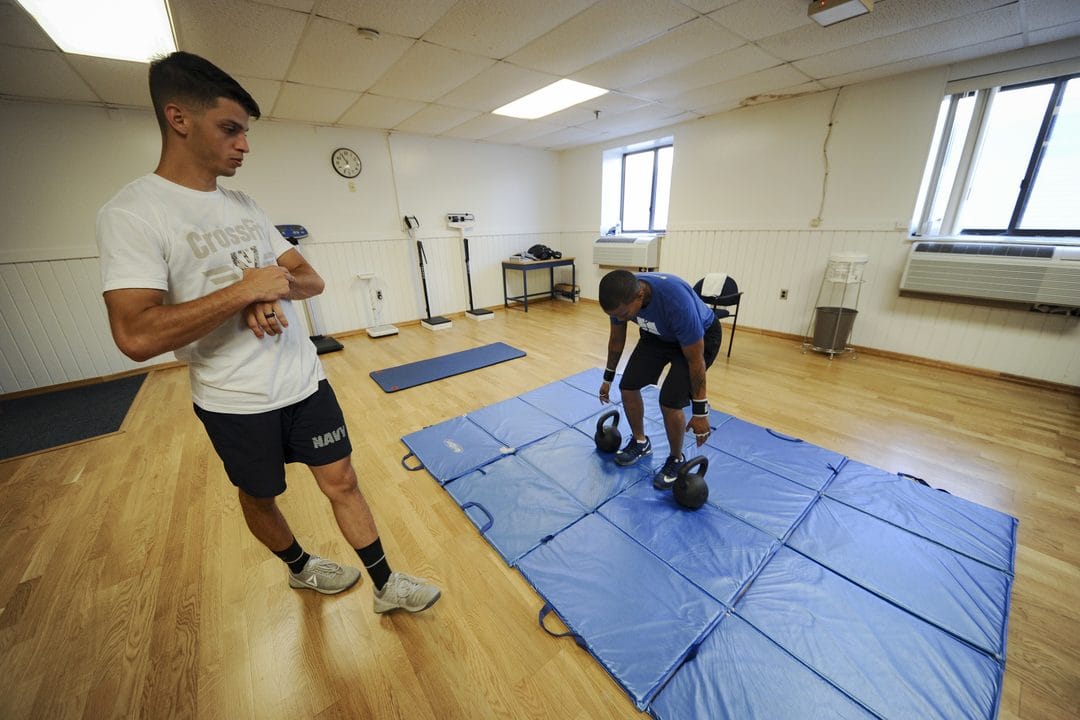
Skip the rubber grip trainers and the wrist-curl machine in the corner of the gym — they build isolated forearm endurance, not the kind of full-body strength that shows up in the studies above. Farmer's carries and dead hangs do the job properly, because they force your grip to work under real load while your whole posterior chain is engaged at the same time. A workable starting programme looks like this: twice a week, pick up a pair of heavy dumbbells or kettlebells — something that feels like 70–80% of what you could carry for one attempt — and walk 20 to 30 metres, rest ninety seconds, and repeat for three or four rounds. On the same days, add dead hangs from a pull-up bar: three sets, holding for as long as you can without your grip failing, aiming to add five seconds a week. Within eight to twelve weeks, most men see a measurable jump on the dynamometer, and the transfer to everyday tasks tends to show up even sooner than the number does — carrying the shopping in one trip, opening a stubborn jar, holding a toddler on one hip while unlocking the front door with the other hand. None of it requires a gym membership; a pair of secondhand kettlebells and a doorway pull-up bar covers the whole programme for under £60.
Buy the £30 dynamometer, test yourself this weekend, and test again in three months. It's the cheapest longitudinal health data you'll ever collect on yourself.