Sleep Apnoea in Men: What STOP-BANG Actually Catches (and Why Most Men Skip It)
Sleep apnoea is markedly more common in men, yet most cases go undiagnosed for years. Here's how the eight-question STOP-BANG tool flags risk, and what actually happens after a positive score.
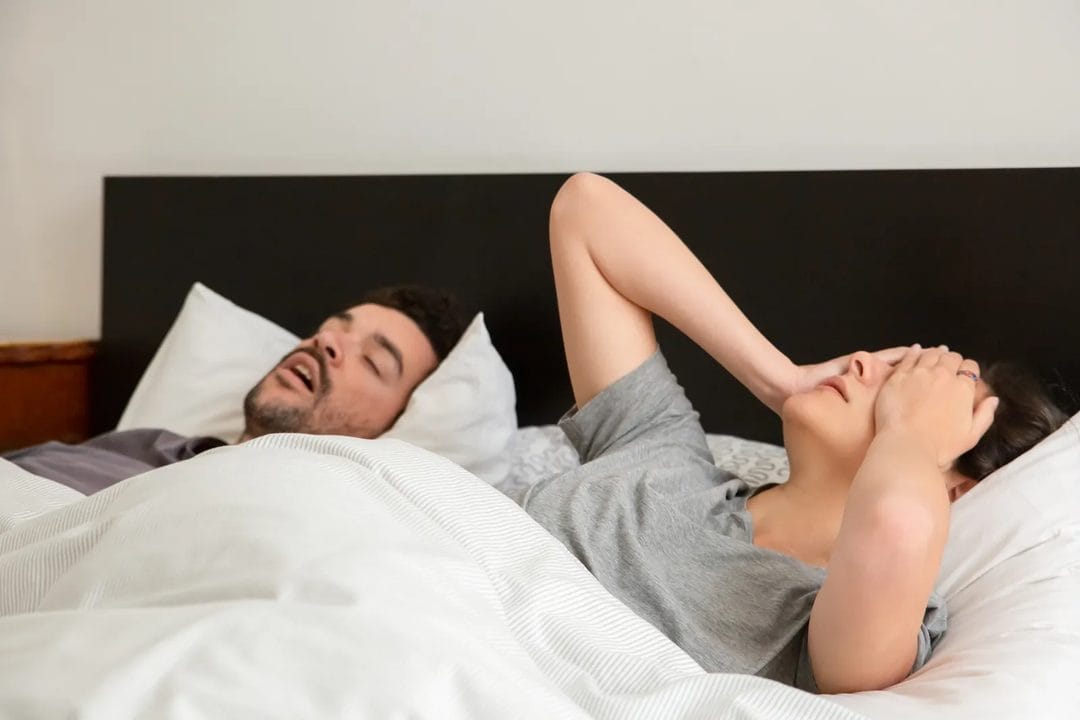
Your partner nudges you awake because you've gone quiet mid-snore for what felt like too long. You slept a full eight hours. By eleven the next morning you're reaching for a third coffee and still fighting to keep your eyes on the motorway. If that pattern sounds familiar, you're carrying a strong candidate for obstructive sleep apnoea (OSA) — and if you're a man, you're considerably more likely to have it than the woman sitting next to you, and considerably less likely to have been asked about it at your last GP appointment.
OSA happens when the soft tissue at the back of the throat collapses repeatedly during sleep, partially or fully blocking the airway. Each blockage triggers a brief, often unremembered awakening as the brain forces the airway open again. Do that dozens of times an hour, every night, for years, and the damage isn't limited to feeling tired — it's linked to high blood pressure that resists standard medication, irregular heart rhythms including atrial fibrillation, and a measurably higher risk of drowsy-driving incidents. The DVLA takes this seriously enough that excessive sleepiness affecting your ability to drive safely is something you're legally required to report, apnoea diagnosis or not.
The eight questions that flag it
STOP-BANG is the screening tool most GPs and pre-operative anaesthetic teams actually use, mainly because it takes ninety seconds and needs no equipment. It's eight yes/no items: Snoring loud enough to be heard through a closed door, daytime Tiredness even after adequate sleep, Observed pauses in breathing during sleep, high blood Pressure, a BMI over 35, Age over 50, a Neck circumference over 40cm, and male Gender. Score one point per "yes." Nought to two points means low risk. Three to four is intermediate. Five or above is high risk, and at that point a GP should be talking to you about a referral rather than reassurance.
Notice that last item. Being male is worth a point on its own, independent of your weight, your neck size, or how loudly you snore. That's not an arbitrary inclusion — men are anatomically more likely to carry fat around the neck and upper airway rather than the hips, and that distribution narrows the airway in exactly the place that matters for apnoea. Hormonal differences play a role too: testosterone appears to influence airway muscle tone and fat deposition in ways that make collapse more likely during sleep. None of that means women are immune — post-menopausal women catch up in risk fairly sharply — but at working age, the tilt toward men is real and it's baked directly into the scoring tool. Some clinicians grumble that a single-sex weighting oversimplifies a genuinely varied condition, and they have a point, but the point of a screening tool isn't nuance — it's catching the people who'd otherwise slip through.
Why the men who need it most rarely get screened
Here's the awkward part. The demographic STOP-BANG is designed to flag — men in their forties and fifties, often carrying some extra weight, often with borderline blood pressure — is also the demographic least likely to bring "I'm tired all the time" to a GP appointment on its own. Tiredness gets attributed to work, to kids, to just getting older, and it's usually a partner who raises the snoring and the breathing pauses, not the man himself, because the man is asleep when it's happening and has no direct memory of it. A lot of GPs will screen opportunistically if you're already in for something else — a blood pressure check, a pre-op assessment — but they're not going to chase you down for it. Ten minutes filling in eight questions on your own, before the appointment even starts, closes that gap without needing anyone to remember to ask.
Worth saying plainly: if your STOP-BANG score comes out at three or higher, don't wait for your next unrelated appointment to mention it. Book a GP appointment specifically to raise it, and say the score out loud. That single sentence changes how quickly you get referred, because "I think I might have sleep apnoea, here's my STOP-BANG score" moves you into a different conversation than "I've been feeling tired lately."
What actually happens after a positive screen
None of it starts until you say something.
A positive STOP-BANG score isn't a diagnosis — it's a reason to get tested properly. In the NHS, that means a referral to a sleep clinic, where the standard next step is a sleep study measuring your Apnoea-Hypopnoea Index, or AHI: the number of breathing interruptions per hour of sleep. Under 5 is considered normal. Five to fifteen is mild OSA. Fifteen to thirty is moderate. Above thirty is severe, and at that level treatment stops being optional if you want to protect your heart and your blood vessels over the next twenty years.
Most people now get a home sleep test first rather than an overnight stay in hospital — you take a small monitor home, wear it to bed for one or two nights, and a sleep physiologist reads the data. It's less accurate than full in-lab polysomnography, which also tracks brain waves and eye movement, but it's good enough to catch the majority of moderate-to-severe cases, and it's what most NHS trusts use as the first line under NICE guideline NG202. Private versions of the same test run somewhere in the region of £150 to £400 if you don't want to wait for an NHS slot, though waiting times vary enormously by trust.
Treatment isn't one-size-fits-all — and CPAP isn't the whole story
Continuous positive airway pressure — CPAP — is still the first-line treatment for moderate and severe OSA, and it works: a mask delivers a steady stream of pressurised air that physically holds the airway open all night. ResMed and Philips Respironics machines dominate the NHS supply chain, and if your AHI clears the threshold for clinical need, the machine itself is provided free. The catch nobody mentions upfront is compliance — a meaningful proportion of people prescribed CPAP stop using it within the first year because the mask feels claustrophobic, the noise bothers a partner, or the whole ritual of strapping in every night just doesn't stick. If that's you, say so at your follow-up rather than quietly abandoning it; there are different mask styles, pressure settings, and humidifier options that solve most of the common complaints.
For mild cases, or for people who genuinely can't tolerate CPAP, the alternatives are real but more modest in effect. A mandibular advancement device — a custom-fitted mouthguard that shifts the lower jaw slightly forward — can meaningfully reduce mild-to-moderate OSA and suits people who mainly need something for travel or as a CPAP backup. Losing 10% of body weight can lower AHI substantially in people carrying excess weight around the neck and abdomen, though it rarely eliminates moderate-severe apnoea outright. Cutting evening alcohol helps because alcohol relaxes throat muscles specifically during the hours you're trying to breathe steadily. And for the subset of men whose apnoea is largely positional — worse on their back, better on their side — a positional trainer that buzzes gently when you roll onto your back can do more than a mouthguard costing four times as much.
The screening tool is only useful if you act on it
None of this replaces an actual conversation with your GP, and nothing in a STOP-BANG score should be treated as a diagnosis you can self-manage with a £30 mouthguard from a pharmacy website. What it's genuinely good for is cutting through the "I'm just tired" story men tell themselves for years before someone else notices the breathing pauses. Run the eight questions honestly tonight. If you land on three or more, that's not a maybe — book the appointment, say the score, and let the sleep clinic take it from there.