VO2 Max: The Single Best Predictor of How Long You'll Live
One metric predicts all-cause mortality better than cholesterol, blood pressure, or smoking status. VO2 max. And you can improve it substantially at any age.
A 2018 JAMA Network Open study of over 120,000 adults followed for more than 20 years found that VO2 max was the single strongest predictor of all-cause mortality — more predictive than smoking status, diabetes, hypertension, or elevated cholesterol. Moving from the bottom fitness quintile to the next-to-bottom cut mortality risk in half. Moving to the top quintile cut it by 80%.
That's not a rounding error. The effect size of VO2 max on lifespan dwarfs most medical interventions. Improving fitness into middle age and beyond is probably the highest-leverage health intervention available to most men.
The good news: VO2 max can be improved substantially at any age with appropriate training. The bad news: most men over 40 have a VO2 max of untrained sedentary levels, and without intentional training, it declines about 10% per decade.
What VO2 Max Is
VO2 max is the maximum rate at which your body can use oxygen during exercise. It's measured in ml of oxygen per kg of body weight per minute (ml/kg/min). Higher values indicate better aerobic fitness — your cardiovascular and respiratory systems deliver and use more oxygen under maximum demand.
VO2 max integrates:
- Heart pumping capacity (stroke volume and max heart rate)
- Blood oxygen-carrying capacity (hemoglobin levels)
- Muscle oxygen extraction and utilization (mitochondrial density and function)
- Capillarization in muscle
- Neuromuscular coordination under high demand
It's the clearest single number for overall aerobic system capacity.
Why It Predicts Mortality
VO2 max reflects general cardiovascular and metabolic health. A high VO2 max typically means:
- Functional heart capacity
- Healthy vascular system
- Good mitochondrial function
- Likely metabolic flexibility
- Sufficient skeletal muscle
- Adequate recovery capacity
Low VO2 max suggests the opposite across multiple systems. It's a composite indicator that's hard to fake — you can't have a high VO2 max without all the underlying systems working reasonably well.
Physiological reserve matters enormously with age. A 70-year-old with VO2 max of 40 ml/kg/min has substantial reserve for illness, injury, or activity. A 70-year-old with VO2 max of 20 is operating near functional capacity limits — minor setbacks can tip into inability to manage daily activities.
Reference Values
Typical VO2 max ranges for men:
| Age | Low | Average | Above Average | Excellent |
|---|---|---|---|---|
| 30-39 | <30 | 30-37 | 38-45 | 46+ |
| 40-49 | <27 | 27-34 | 35-42 | 43+ |
| 50-59 | <24 | 24-31 | 32-39 | 40+ |
| 60-69 | <21 | 21-28 | 29-35 | 36+ |
Elite endurance athletes can reach 70-90+ ml/kg/min. These are genetic outliers with dedicated training; most men won't reach such levels regardless of training.
Aging sedentary men often have VO2 max in the 20-28 range. Moving toward above-average levels through training meaningfully reduces mortality.
How to Measure
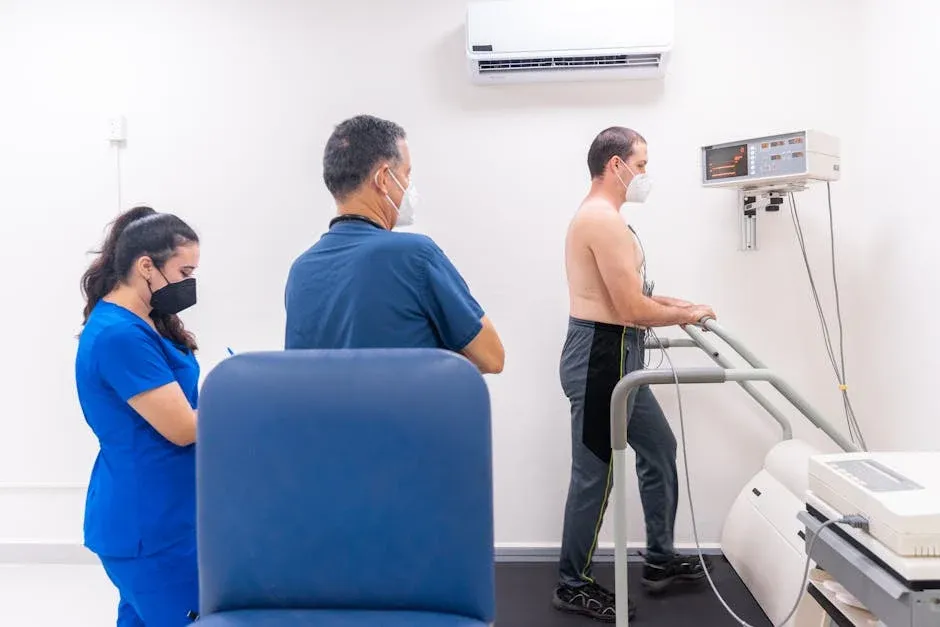
Lab test (CPET). Cardiopulmonary exercise test — mask-based measurement of expired gases during progressive exercise to exhaustion on treadmill or bike. Gold standard. $150-400 direct-to-consumer. Available at hospital exercise physiology labs, university athletic programs, and specialized performance centers.
Submaximal estimates. Various tests (Rockport walk test, YMCA step test, Cooper 12-minute run) estimate VO2 max from performance. Less accurate than CPET but free.
Wearables. Apple Watch, Garmin, WHOOP, and others estimate VO2 max from heart rate during exercise. Accuracy varies. Useful for tracking trends on the same device; absolute values less reliable than lab testing.
For serious assessment: a CPET is the reference. For general trends and tracking: wearable estimates work adequately.
How to Improve VO2 Max
VO2 max responds well to training across ages. Evidence-based training approaches:
Zone 2 cardio. Sustained moderate-intensity aerobic work at ~60-70% of maximum heart rate. 3-5 hours per week. Primary driver of mitochondrial adaptations and capillarization. The "base" of endurance fitness.
High-intensity intervals. 4-6 min intervals at near-max effort with equal rest periods. 1-2 sessions per week. Drives cardiac adaptations, increased stroke volume. Examples: 4x4 min intervals, Tabata-style protocols, hill repeats.
Polarized training. Combining 80% of weekly training volume in Zone 2 with 20% in high-intensity. Elite endurance training model; applies well to recreational training.
Avoid the middle. Too much training at moderate-hard pace (Zone 3) accumulates fatigue without optimal adaptations. The "gray zone" is where many men train unproductively.
What to Expect
A sedentary 45-year-old man starting structured training:
- Baseline: ~25-28 ml/kg/min
- After 3 months of 3-4 hrs/wk training: 30-33
- After 12 months consistent training: 38-42
- After 2-3 years continued training: 42-48
Improvements of 30-50% are achievable in previously untrained men over 1-2 years of consistent training. After that, improvement slows but fitness can be maintained.
The Decline Without Training
Without regular aerobic training, VO2 max declines roughly 10% per decade starting around age 30. By age 80, a sedentary man has about 60-65% of his age-30 VO2 max.
Training dramatically slows this decline:
- Sedentary: ~10% per decade
- Moderately active: 5-7% per decade
- Highly trained: 3-5% per decade
Training can delay reaching any given threshold by 10-20 years. A fit 70-year-old may have the VO2 max of a sedentary 50-year-old.
Strength Complements Aerobic
VO2 max focuses on aerobic capacity. Comprehensive fitness requires strength training as well:
- Muscle mass preservation
- Bone density
- Functional capacity
- Metabolic health
- Injury resistance
A man with high VO2 max but minimal strength has half the picture. Combined aerobic and strength training is the ideal model for most men.
Specific Training Prescription
Example weekly schedule for a 45-year-old aiming to improve VO2 max:
- Monday: Strength training (45-60 min)
- Tuesday: Zone 2 cardio (45-60 min)
- Wednesday: HIIT (30-35 min) or strength training
- Thursday: Zone 2 cardio (45-60 min)
- Friday: Strength training (45-60 min)
- Saturday: Zone 2 cardio (60-90 min)
- Sunday: Rest or active recovery
Time commitment: 5-6 hours per week. Ambitious but achievable for many. Lower-volume programs still produce benefits.
Equipment Choices
Any sustained aerobic modality works:
- Running: high-impact, easy logistics, weather-dependent
- Cycling: low-impact, higher equipment cost, excellent Zone 2 training
- Rowing: full-body, low-impact, equipment cost
- Swimming: low-impact, technique-dependent
- Elliptical: low-impact, often underloaded
- Hiking: weather and access dependent, less consistent training stimulus
Mix is fine. What you do consistently matters more than specific modality.
Barriers
Common reasons men don't train aerobically:
- Time constraints
- Joint issues
- Lack of access to equipment
- Uncertainty about how to train
- Boredom with prolonged exercise
- Confusion from conflicting recommendations
Solutions:
- 5-6 hours per week is substantial but not extreme
- Low-impact modalities for joint issues
- Home equipment (stationary bike) for convenience
- Simple structure (Zone 2 most days, one harder session weekly)
- Podcasts, audiobooks, or music during Zone 2
- Clear evidence-based framework beats latest fad
The Long View
VO2 max training pays off over decades. Men who start in their 40s and maintain training for 30 years have dramatically different functional profiles at 75 than men who don't.
The ability to play with grandchildren, travel actively, maintain independence, and recover from medical events depends on cardiovascular and metabolic reserve. VO2 max is the clearest single proxy for this reserve.
Medical Considerations
Before starting aggressive aerobic training, particularly in middle-aged men:
- Address cardiovascular risk factors (blood pressure, lipids, blood sugar)
- Consider cardiovascular evaluation if significant risk factors
- Cleared for exercise stress testing if recent cardiac symptoms
- Gradual progression rather than immediate high intensity
For most healthy men, aerobic training is safe to start at any age. Progressive loading, attention to recovery, and appropriate warm-up reduce injury risk.
The Practical Summary
VO2 max is the best single predictor of longevity in men. It declines without training and improves with training. The time investment (3-6 hours weekly) is substantial but manageable. The benefits are substantial and durable.
Test your VO2 max, or estimate from a wearable. Assess your current position. If below age-appropriate average, training can improve it meaningfully. If already above average, maintain it. The payoff extends across decades.
Among all health investments available, structured aerobic training probably offers the highest return. Cheaper than any medication, more effective than most supplements, and the benefits compound over time. Start.